
| Type | Indigenous |
|---|---|
| Family | Magnoliaceae |
| Synonym | Michelia champaca L. |
| Local Name | Chempakam |
| Habit | Medium sized tree |
| Tree Seed | Fruit type: Capsule Seed weight: 12000 to 16900 seeds/kg (Luna, 1996; Chacko et al., 2002) Vernacular name: Champakam (Malayalam); Shembuga, Sempangan (Tamil) (Chacko et al., 2002). Champa (Hindi) (Gamble, 1922) Flowering season: Summer and in Rainy season. March to June and may continue till the end of rains (Bose et al., 1998) Fruiting season: Ripens in August, throughout the year (Bose et al., 1998); November to December (Bourdillon, 1908). August to September (FRI, 1975) and March to april (Luna, 1996; Chacko et al., 2002) Germination type: Epigeal (Chacko et al., 2002) Germination percentage: Up to 80 (Chacko et al., 2002) Method of propagation: By seeds and vegetative method. Six- to eight-month-old seedlings are cut to a height of 25-30 cm above the ground and a slit was made in the rootstock. Defoliated scions are cut into a wedge shape and inserted into the slits and the junction is wrapped w |
| Botanical Features | Evergreen trees, bole straight; bark surface grey with numerous pits; blaze yellow; branchlets lenticellate, scarious; lenticels elliptic. Leaves simple, alternate; stipules 1-2.5 cm long, lateral, adnate to the petiole, ovate, subglabrous, enclosing leaf buds, deciduous, leaving annular scar; petiole 10-30 mm long, slender, pubescent, grooved above; lamina 8-25 x 4-10 cm, ovate, ovate-lanceolate, elliptic-lanceolate or elliptic-oblong, base acute, apex acuminate, margin entire, wavy, glabrous above, puberulent beneath, surface alveolate, coriaceous; lateral nerves 8-18 pairs, pinnate, prominent; flowers bisexual, yellow or white, fragrant, 4-5 cm across, axillary or terminal, solitary; flower bud enclosed by a greenish-yellow, spathaceous, pubescent, coriaceous, deciduous bracts; fruit an aggregate of capsules 1.5 x 1 cm, ovoid to ellipsoid, white sparkle; seeds 3-4, enclose by fleshy red aril. |
| Habit | 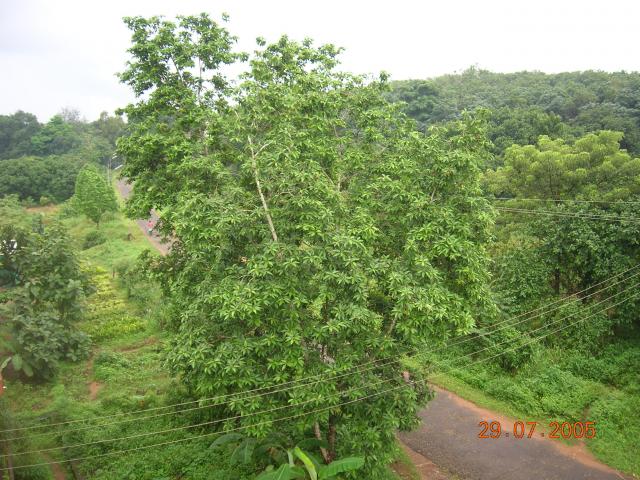 |
| Leaf | 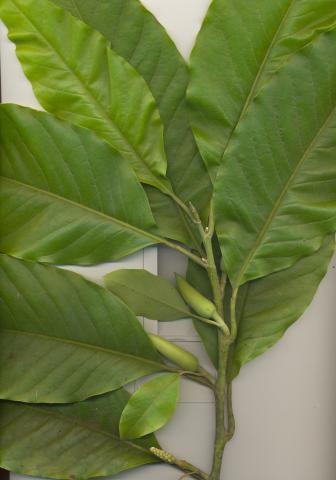 |
| Flower | 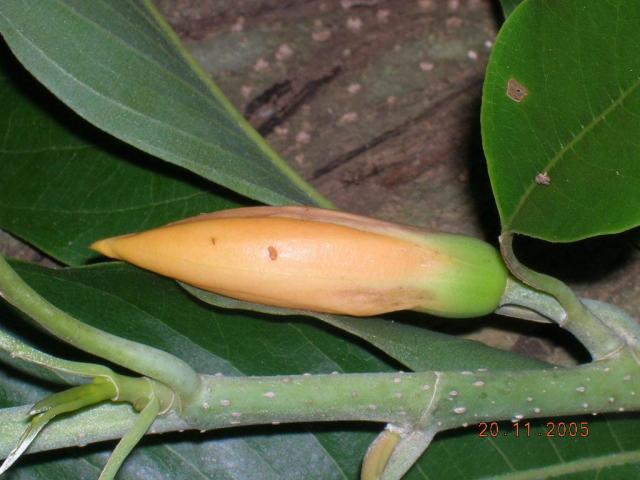 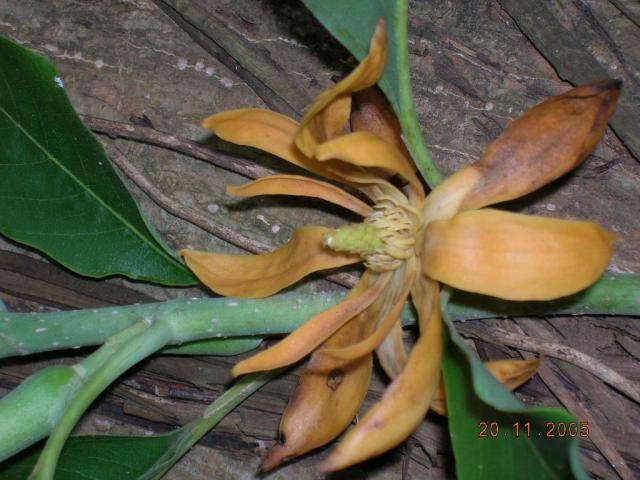 |