
| Type | Indigenous |
|---|---|
| Family | Bombacaceae |
| Synonym | Bombax malabaricum DC. |
| Synonym_2 | Salmalia malabarica (DC.) Schott & Endl. |
| Local Name | Poola |
| Local Name 2 | Mullilavu |
| Habit | Large to very large sized tree |
| Tree Seed | Fruit type: Capsule. Seed weight: 23,986 to 52,911seeds/kg (Sen Gupta, 1937 from Chacko et al., 2002); 11,000 to 22,000 seeds/kg (Kindt et.al., 1997; Chacko et al., 2002); 2,14,000 to 3,85,000 seeds/kg (Carlowitz, 1991; Chacko et al., 2002). Vernacular name: Elavu, Pulamaram, Mullilavu, Poola (Malayalam); Mulelavu, Illavam (Tamil); Semal (Hindi); Burla, Sauvi (Kannada) (Chacko et al., 2002). Flowering season: January to March (Brandis), February to March (Bose et al., 1998). Fruiting season: April to May (Sahni, 2000). Germination type: Epigeal (FRI, 1981; Chacko et al., 2002). 30oC is the optimum temperature for germination (Varela et al., 1999). Germination percentage: 14 to 100 (Sen Gupta, 1937; Chacko et al., 2002). Method of propagation: By seeds and budding (Venkatesh et al., 1978). |
| Botanical Features | Deciduous trees; bole straight, buttress 1-2 m high, armed with conical prickles; bark 20-30 mm thick, grey mottled with white, longitudinal fissures shallow; blaze pink, marked with triangular rays; branches horizontal and more or less whorled; branchlets prickly. Leaves digitately-compound, alternate, stipulate; stipules small, lateral; rachis 12-25 cm, stout, swollen at base, glabrous; leaflets 5-7, whorled; petiolule 14-25 mm long, stout, glabrous; lamina 10-20 x 2-6 cm, elliptic, elliptic-ovate or elliptic-obovate; base attenuate or cuneate; apex caudate-acuminate; margin entire, glabrous, chartaceous; lateral nerves 8-14 pairs; flowers bisexual, dark crimson, 6-7 cm across, solitary or 2-5 together; fruit a capsule, 8-10 x 3 cm, downy tomentose, cylindrical, blackish and glabrous at maturity, the columella brownish; seeds numerous, pyriform, smooth, dark brown, embedded in white cotton. |
| Habit | 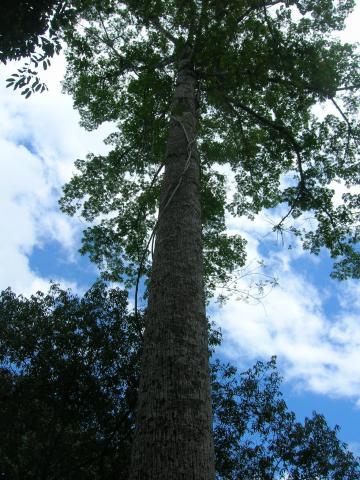 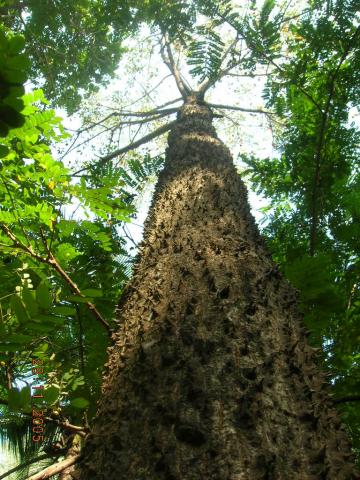 |
| Leaf | 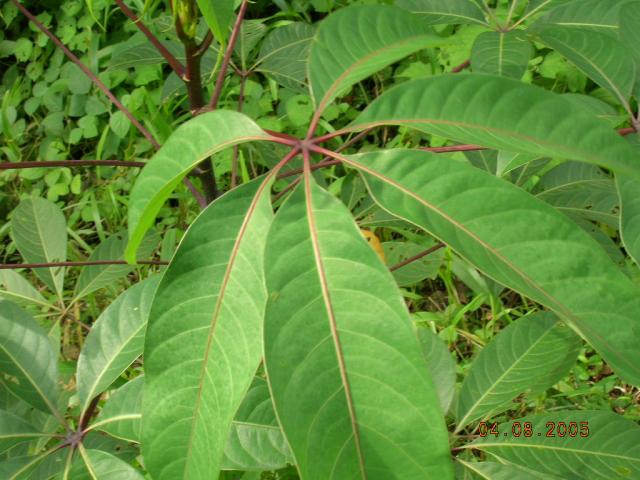 |
| Flower | 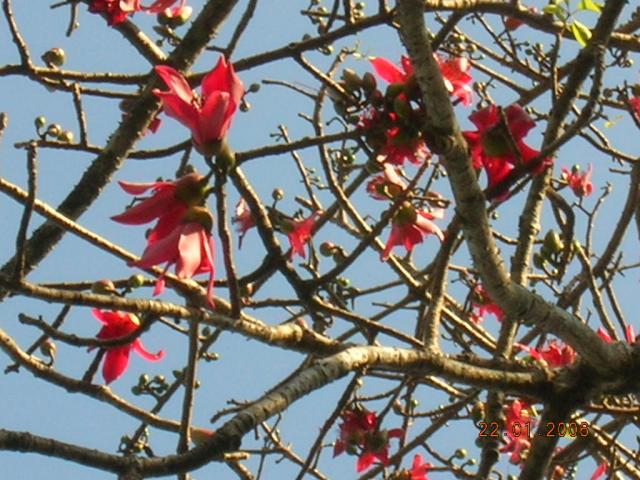 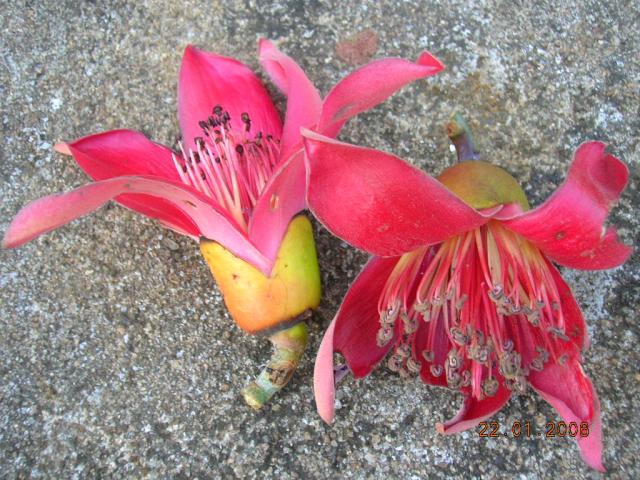 |
| Fruit | 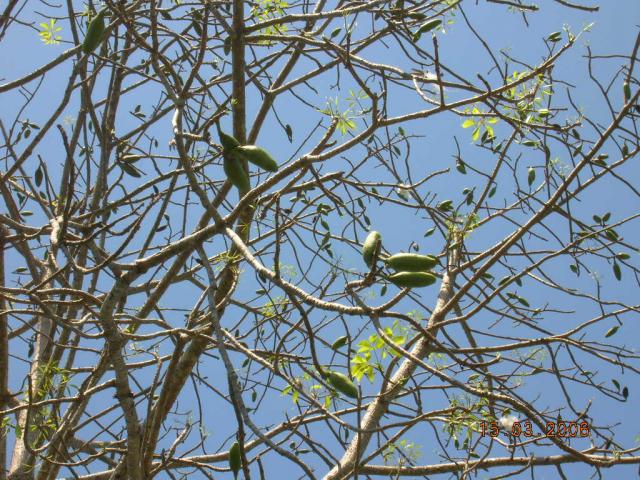 |